The Path Starts at the Gate: A Farmhouse Primer on Public Footpaths
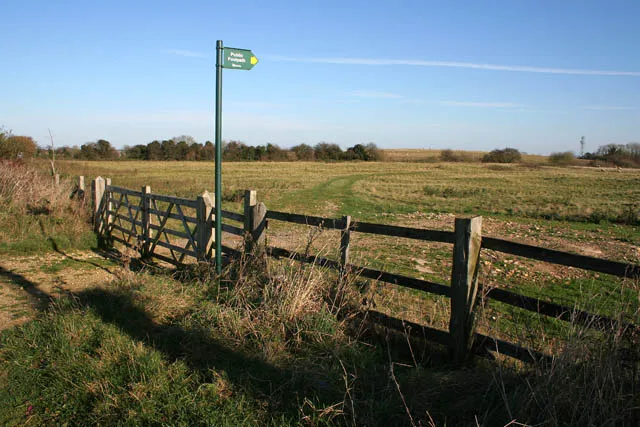
Photo: Kate Jewell, CC BY-SA 2.0, via Wikimedia Commons
There is a particular kind of morning at a farmhouse when you step out of the back door, latch it behind you, and find a yellow arrow pointing across a field. No car keys. No sat-nav. No debate about where to park. The walk has already begun. That is the quiet luxury of a rural stay: not the thread count or the coffee machine, but a front door that opens straight onto a signed route.
At Drem Farmhouse, we like a walk that starts with a latch rather than a car park. And while the countryside does not ask you to sit an exam before setting off, a little fluency in arrows, gates and path signs makes the whole weekend feel larger. Here is how to read the small print underfoot.
The Front Door That Opens onto a Footpath
Britain's path network is one of those quiet pieces of infrastructure that most of us only notice when it fails us. A public right of way can cross a field, slip behind a hedge, run along the edge of a wood and deliver you to a village pub without asking permission from anyone. It is not a theme park. It is not a guided experience. It is simply a line on the map that says: you may walk here.
For a farmhouse guest, that line is the real luxury. A signed route from the door means you can walk out before breakfast, return muddy, and still have the day ahead of you. It means the weekend does not depend on the car. It means the landscape is not something you view from a lay-by but something you move through, stile by stile, until the kettle is back in sight.
What the Waymarks Are Telling You
Waymarks are the countryside's punctuation. In England and Wales, a yellow arrow is usually a public footpath — walkers only. A blue arrow tends to mark a bridleway, where horses and cyclists share the line. A white arrow often points along a permissive path or a local link, which is a polite way of saying the landowner has invited you across rather than been obliged to let you. Red and purple waymarks can indicate byways and restricted byways, but for most farmhouse weekends the yellow, blue and white arrows are the ones you will meet.
Scotland is different again. The right to roam is broader, waymarking is less uniform, and the expectation is that you use a map and your judgement rather than follow a painted arrow through every gate. That is not a reason to leave the map at home. It is a reason to pack it.
The useful habit is simple: when you meet a waymark, read it as a sentence, not a decoration. Which path is it pointing along? Does the arrow send you across the middle of the field or around the edge? Is there a second sign, perhaps smaller and lower down, that says 'permissive' or names a farm? The small print is usually where the truth lives.
Stiles and the Art of the Kissing Gate
A stile is a small piece of negotiation. Some are sturdy wooden steps, worn smooth by decades of boots. Some are stone slabs set into a wall. Some are kissing gates — the swinging wooden or metal enclosures that let a walker through while keeping livestock where they belong. The design tells you something about the landowner's patience. A well-kept stile suggests someone expects walkers and does not resent them. A stile that has been half-hearted for years suggests the opposite.
Either way, the etiquette is the same. Close gates behind you unless they are pinned open or a sign says otherwise. Do not climb walls or hedges to save a few yards. If a gate is stiff, lift it rather than drag it. And if a dog needs to be carried over a stile, carry it — a farm animal's field is not the place for a negotiation.
The kissing gate is also a useful reminder that the path is shared. You are a guest in someone's working landscape, even when the law says you have every right to be there. Good manners cost nothing and keep the welcome warm.
Right of Way, or a Favour?
A right of way is a permanent line on the map. A permissive path is a courtesy. Both can be lovely. Only one can be relied upon next year. If a sign says 'permissive path', enjoy it, but understand that the landowner can close it or divert it. That does not make it less pleasant. It just makes it less guaranteed.
This matters most when you are following a route from a guidebook or a phone screen. The arrow on the ground is the authority. If the path ahead looks boggy, do not assume the muddy desire line is the official route. The desire line is the shortcut everyone takes; the arrow is the route the farmer expects. Follow the arrow across the field, even if it adds a few paces. Your boots will thank you, and so will the field.
Habits Worth Packing
You do not need a expedition kit for a farmhouse weekend, but a few small habits make a signed route much more enjoyable.
- A paper map, or the local Ordnance Survey Explorer sheet, folded into a pocket. Phones are excellent until a gatepost eats the signal.
- A note of the nearest pub on the loop — not just for lunch, but as a landmark and a warm place to recalibrate.
- A charged phone and, if you are out all day, a small power bank.
- A dry bag or sandwich bag for the map, because British weather likes to test your paperwork.
- The willingness to turn back. A path is not a challenge; it is a pleasure.
The Last Stile Before Home
There is a moment on every good farmhouse walk when the last stile comes into view and you know the kettle is close. Treat that stile as the proper end of the walk, not an inconvenience before tea. Pause. Look back at the field you have crossed. Shake the mud from your boots. Then unlatch the door and let the warmth find you.
A farmhouse weekend does not need to be adventurous to feel expansive. It just needs a path that starts at the gate, an arrow you can trust, and the good sense to follow it.