When the Square Fills: A Farmhouse Weekend Built Around Market Day
A farmhouse weekend can be planned two ways. You can build a list of attractions and drive between them, or you can choose one fixed point on the local calendar and let the rest arrange itself around that. The village market is the better fixed point. It does not just fill a morning; it tells you when to arrive, what to cook, where to walk, and when to leave the car keys alone. The trick is arithmetic — not the spreadsheet kind, but the country kind: market opening times plus daylight plus a café stop plus a footpath. Get that sum right and the weekend has a rhythm before you have even unpacked.
Start with the calendar, not the map
Before you book a farmhouse, find out which market is nearest and when it runs. This sounds obvious, but markets keep very different hours. Some are weekly street markets with the same stalls in the same places for generations. Some are monthly farmers' markets that appear in a hall or square and vanish by lunchtime. Some towns still hold a livestock auction on a set day, with the producers' stalls arriving later and the café doing a steady trade in between. In 2026, most of this information sits on town council pages, local newsletters and the market's own social media, but a quick phone call to a tourist information point will often tell you more than any listing.
Once you know the day, the weekend shape follows. If the market is on Saturday, book the Friday and Saturday nights and arrive in time for an unhurried Friday supper. If it is on Thursday, a midweek break makes more sense than a rushed weekend. If it is monthly, book early and treat the date as the reason for the trip rather than an afterthought. The aim is not to cram the market in beside everything else. It is to let the market decide what everything else can be.
The square usually holds two markets
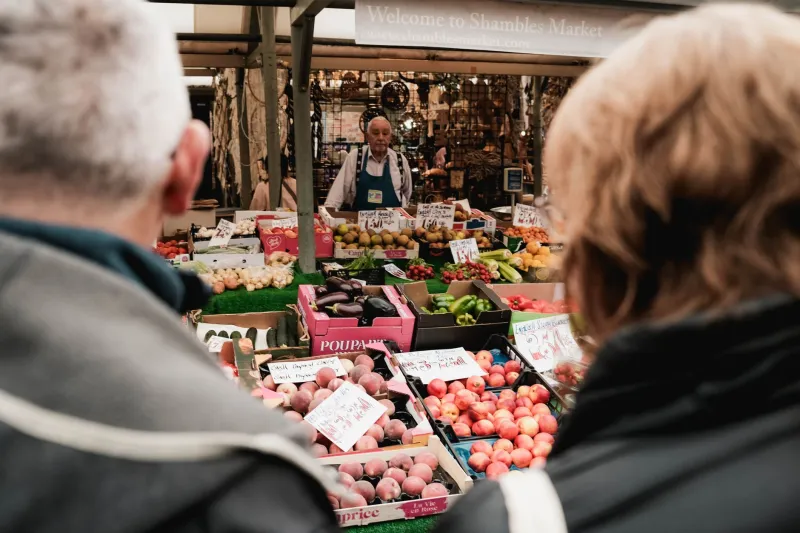
Many village market days are really two events sharing the same space. Early on, there is the working market: livestock pens, trailers, a forklift, farmers in boots talking in shorthand. Later, the producers' stalls take over: bread, cheese, apples, chutney, sausages, plants, maybe a knife sharpener or a man selling wool socks. Both are worth seeing, but they ask for different manners. The auction is not a tourist attraction. If you go, stand back, keep your voice low, do not block the pens, and do not treat a working animal as a photo opportunity. The producers' stalls are friendlier ground for browsing, though even there a simple question — how would you cook this? — will get you further than a silent inspection.
You do not have to do both. A good market morning might be an early look at the pens, a slow coffee while the square fills, and then a proper shop once the stalls are ready. Or it might be a later arrival, straight into the producers' rows, with the auction already finished and the town settling into its Saturday self. The arithmetic works either way, as long as you leave room for the pace of the place.
Buy for the kitchen you actually have
A farmhouse kitchen is not a supermarket. Before you shop, check what is there: the size of the fridge, whether there is a freezer shelf, what pans and oven trays you can rely on, and whether the kettle is the sort that takes a while. Then buy accordingly. A market shop for a weekend should look like a picnic with ambition, not a harvest festival. Bread, cheese, a bag of apples, a jar of something sharp, a few sausages, a bunch of greens: that is usually plenty.
Ask the stallholder how they would cook what you are buying. This is not a test; it is the best part of the transaction. The person selling you a wedge of cheese often knows exactly what it wants to be with, and the person selling you a punnet of damsons has probably made more jam than you ever will. Carry a cool bag if you are buying meat or dairy and plan to walk afterwards. And resist the urge to buy a week's vegetables for two nights simply because the colours look good. The farmhouse fridge is smaller than the market's ambition.
The café stop anchors the walk home
The café is not an afterthought. It is the anchor. A market without a sit-down is just a shopping trip with worse parking. Find the place where the locals are eating: a proper teapot, a bacon buttie, a slice of cake that has not been designed by a committee. Sit near the window if you can. Listen to the town. Read the noticeboard by the door, which will tell you about the next market, the church fete, the missing cat, and the footpath that is temporarily closed after the storm.
This is also the moment to check the weather and the route. A market morning can turn into a full day very easily, but only if you stop long enough to notice what is available. The café is where the market becomes a walk, and the walk becomes the reason you came.
Put a footpath at one end
The best farmhouse market weekends have a footpath attached. Sometimes the market square is the start of a route; sometimes it is the finish. If you are buying perishables, walk first and shop second, or shop first and keep the loop short. Use an Ordnance Survey map or a reliable walking app, check the rights of way, and take the boots that can handle mud rather than the ones that look good by the door.
A village market often sits at the end of a path that has been used for centuries, even if the route now passes a car park and a new housing estate. Walk it anyway. Keep to the path, close the gates, and put the dog on a lead around livestock. Come back into town with the smell of the fields still on your jacket and the bread in your bag. That is the point. The market is not a detour from the walk; it is the place where the walk lands.
The arithmetic that actually matters
Add up the fixed things: market opening and closing times, café last orders, daylight, check-in, the pub's lunch service, and whether the town shuts early on a Sunday. Then leave slack. A market day is a fixed point, but the rest of the weekend should be flexible. If the market finishes at one, do not plan a ten-mile walk after it. If the auction starts at nine, have breakfast earlier. If the market is monthly, book the farmhouse as soon as the date is confirmed.
This is not rigidity. It is scaffolding. The market gives the weekend a spine, and the farmhouse gives it a soft place to land. You come home with muddy boots, a bag of local cheese, a newspaper you did not need, and a route you will want to repeat. In 2026, when so much of a break can be booked, browsed and optimised in advance, a market day is pleasantly unoptimisable. It starts when it starts. You turn up, buy what is good, walk it off, and let the farmhouse do the rest.